What Can a Facelift Revision Correct? A Weston, FL Surgeon Explains
By Shashi Kusuma, MD, board certified by the American Board of Plastic Surgery and the American Board of Otolaryngology; former Staff Surgeon, Cleveland Clinic Ohio. SURIA Cosmetic Surgery & Med Spa (The Face Doctor of Florida), Weston, FL. Medically reviewed by Dr. Kusuma. Updated November 11, 2026.
What is a facelift revision, and what can it fix?
A facelift revision (secondary facelift) is surgery to correct or refine an earlier facelift. It can often fix a tight or pulled look, visible or widened scars, pulled-down earlobes (pixie ear), a shifted hairline, and jowls or neck looseness that came back. Dr. Shashi Kusuma, a surgeon board certified in plastic surgery and otolaryngology, performs facelift revision at SURIA Cosmetic Surgery & Med Spa in Weston, Florida, for patients across Broward, Fort Lauderdale and Miami.
Most revisions are planned once the tissues have fully healed, often about a year after the first surgery. Recovery is often similar to a first facelift, though swelling can take longer to settle because of scar tissue from the earlier surgery. Dr. Kusuma plans every revision around two questions: what did the first surgery do, and what needs to change now?
Why would a facelift need to be revised?
People seek a revision for many reasons. In Dr. Kusuma’s words, it can be “asymmetry, bad scars, not defined landmarks, ongoing laxity in the neck,” or simply wanting more improvement than the first surgery gave.
Some concerns show up soon after surgery. Others appear gradually, because the face keeps aging after any facelift. A revision doesn’t always mean something went wrong. When Dr. Kusuma talks about scars, he says they are usually “not because something was done improperly… despite our best efforts sometimes it happens… you just have to take care of it.” The same honest approach applies to revision facelifts. The goal is to understand the problem and fix what can be fixed.
Which technique is used for a facelift revision?
Dr. Kusuma often says that “this is how decisions are made, not just arbitrarily.” No single facelift technique is right for everyone, and that matters even more in a revision. Scar tissue, earlier incisions and changed anatomy all affect the plan.
He uses a golf analogy: two great players can swing differently and both play very well. “Surgeons are the same thing.” He also says a surgeon has to “be versatile enough to have the confidence to do all of it or none of it.” Depending on your anatomy, the plan may include:
- Repositioning the deeper facial tissues instead of pulling the skin. This can be done with SMAS elevation, a deep plane approach, or a bilaminar approach, where the deep layer and the skin are moved in different directions. Deep plane is one of several tools. In one secondary facelift he discussed on camera, the patient’s narrow face and existing cheek volume shaped which direction of lift and which technique he chose, because a lift that adds midface fullness isn’t right for every face shape.
- A neck lift, when neck laxity or poorly defined landmarks are the main concern. Depending on the plan, some procedures, including certain neck lifts, can be done under local anesthesia. The type of anesthesia is chosen for your safety and comfort after your exam.
- Scar revision, to move or narrow scars that are widened or poorly placed.
- Earlobe correction, for lobes that have been pulled down or distorted.
- Volume restoration (for example, small amounts of your own fat), which can help when a face looks hollow or overly tight after a first lift, and skin treatments such as laser resurfacing, which may be done at the same time as surgery or as a separate step, decided case by case. In Dr. Kusuma’s approach, these complete a comprehensive, combination facial rejuvenation plan rather than relying on one lift.
He describes facial surgery as physics: “I’m working with gravity… force… shear stress… tissue strength.” A revision has to respect what tissue has already been moved and how much tension it can take.
What can a facelift revision correct?
Can a revision fix a tight, pulled or windswept look?
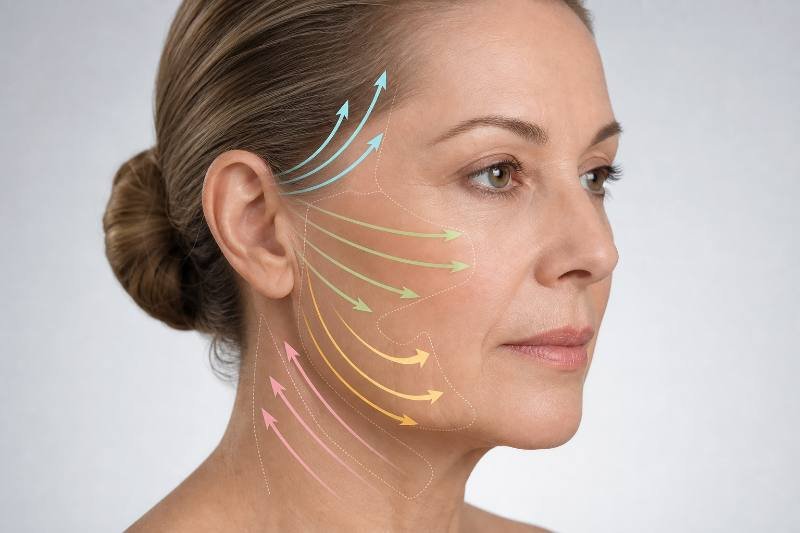
A pulled look usually comes from putting tension on the skin instead of the deeper tissues. A revision can reposition the deeper layers so the skin lies more naturally. How much can be improved depends on your anatomy and on the earlier surgery.
Can pixie ear be corrected?
When the earlobe is pulled down and forward and blends into the cheek, losing its natural free edge, it is often called a “pixie ear.” It usually happens when the lobe ends up carrying tension it shouldn’t. It can be evaluated and often corrected during a revision, as part of the overall plan.
Can facelift scars be improved?
Dr. Kusuma’s ideal scar is thin, flat, matches the surrounding skin color, and sits in natural landmarks. Around the face and ears, he calls this the “highest value real estate.” Raised, thickened scars (hypertrophic scars or keloids) are often treated first with in-office injections, such as a steroid or 5-FU, before any surgical revision is considered. Widened scars can be revised. He compares a widened scar to “an underwear where the elastic band gets loose.” Scars that have lost color (pale scars) are harder to treat. Lasers can improve texture, but they generally can’t reliably bring color back. In medium and darker skin tones (Fitzpatrick types III–VI), any laser treatment also carries a higher risk of new dark spots, so it’s planned carefully. His reassurance: “all of them have solutions… talk to your surgeon.” Watch his scar guide.
Why did my jowls or neck come back, and can it be fixed?
If sagging returns sooner than expected, it may be because aging continued, because of changes in weight or skin quality, or because the deeper support needs more attention this time. The revision plan focuses on the layer that needs support, which often includes the neck.
Can a shifted hairline or sideburn be improved?
Incisions from an earlier surgery can move the hairline or sideburn. This is assessed at the consultation, and the incision plan is designed to protect the hairline and sideburn, and in some cases it can help bring a shifted sideburn closer to a natural position.
What happens at a facelift revision consultation in Weston?
Dr. Kusuma reviews your goals, history and, if you have it, the operative report from your first facelift, then examines your scars, earlobes, hairline and deeper tissues and explains what can realistically change. Photos from before your first facelift help; records help but aren’t required. See how a revision is planned.
Dr. Kusuma’s advice to anyone considering a revision is to choose a surgeon you’re confident in, who listens to your concerns and explains the plan in terms you understand.
What is recovery like after a facelift revision?
Recovery is often similar to a first facelift, though swelling can take longer to settle because of scar tissue from the earlier surgery. Swelling and bruising improve over the following weeks. Because every revision is different, you’ll get a personal recovery plan, and Dr. Kusuma will follow you closely after surgery. Results vary, and no outcome can be guaranteed.
Frequently asked questions
Can a facelift revision fix a pulled or windswept look?
Often, yes. A pulled look usually comes from tension on the skin rather than the deeper tissues, so a revision repositions the deeper layers and lets the skin lie more naturally. How much can change depends on your anatomy and the earlier surgery.
Can pixie ear be corrected in a facelift revision?
A pixie ear is an earlobe pulled down and forward so it blends into the cheek and loses its free edge, usually because the lobe is carrying tension it shouldn’t. It can be evaluated and often corrected as part of a revision plan.
Can facelift scars be improved?
In many cases, yes. Widened or poorly placed scars can be surgically revised. Raised, thickened scars are often treated first with in-office injections such as a steroid or 5-FU. Pale scars are harder to treat, because lasers generally can’t reliably restore lost color.
Why did my jowls or neck come back after a facelift?
Sagging can return because the face keeps aging, because of changes in weight or skin quality, or because the deeper support needs more attention. A revision assesses each layer and usually addresses deeper support and the neck, not just the skin.
How long should I wait after my first facelift before a revision?
The tissues need to heal fully first, which often takes about a year after the original surgery. Dr. Kusuma advises on timing after an exam.
Is a deep plane facelift required for a revision?
No. Deep plane is one of several approaches, along with SMAS and bilaminar techniques. The choice depends on your anatomy, including face shape, volume and what the earlier surgery did.
What is recovery like after a facelift revision?
Recovery is often similar to a first facelift, though swelling can take longer to settle because of scar tissue from the earlier surgery. Swelling and bruising improve over the following weeks, and you get a personal recovery plan.
Where can I get a facelift revision near Fort Lauderdale or Miami?
Dr. Shashi Kusuma performs facelift revision at SURIA Cosmetic Surgery & Med Spa, 2235 N Commerce Pkwy, Suite 2, Weston, FL 33326, and sees patients from Fort Lauderdale, Miami and throughout Broward County. Call (954) 472-8355.
To schedule a consultation, call (954) 472-8355. SURIA Cosmetic Surgery & Med Spa, 2235 N Commerce Pkwy, Suite 2, Weston, FL 33326.